
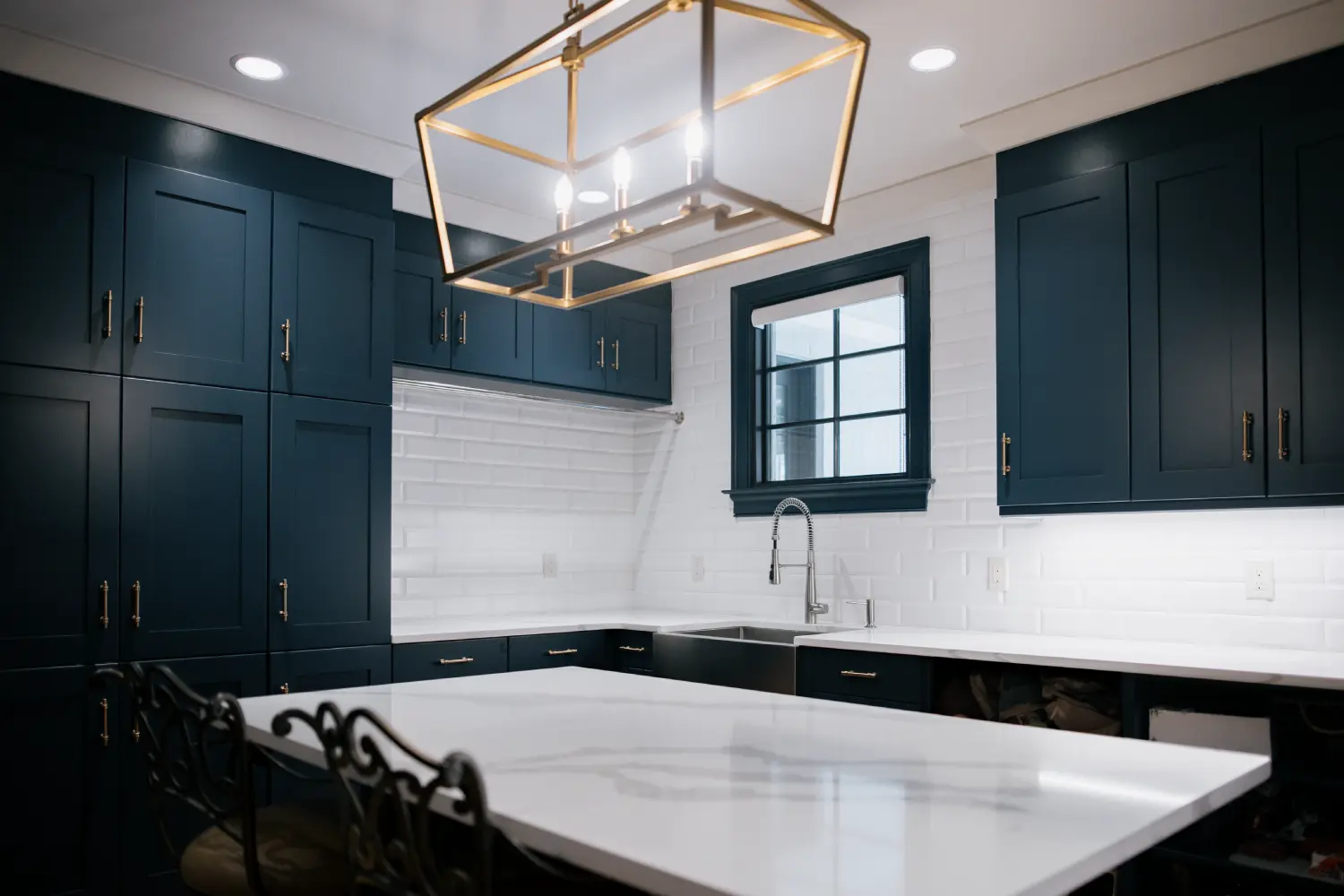
The quartz vs granite countertops debate does not have one universal winner. Both materials are durable, widely used, and available in a broad range of looks. The better choice depends on how you cook, how much maintenance you want, whether you prefer natural variation or controlled patterning, how you use hot cookware, and what appearance fits the kitchen.
Granite is a natural stone cut into slabs, so each piece has its own mineral pattern and variation. Quartz countertops are engineered surfaces manufactured from quartz minerals combined with binders and pigments. That difference affects appearance, maintenance, heat tolerance, and how the material is fabricated.
Top Service Custom Countertops fabricates and installs countertops in Lexington, KY and offers both granite and quartz. This guide breaks down the practical differences so homeowners can choose based on use rather than marketing claims.
What Is Granite?
Granite is an igneous natural stone quarried from the earth and cut into slabs. Its color and movement come from the minerals present in the stone.
Because it is natural, no two slabs are exactly the same. Even slabs from the same block can show variation.
Granite may include:
- speckled patterns;
- sweeping movement;
- veins;
- mineral deposits;
- crystals;
- color shifts;
- natural fissures.
For homeowners who want a one-of-a-kind surface, this variability is often part of the appeal.
What Is Quartz?
Quartz countertops are engineered. Manufacturers combine quartz mineral content with resins, pigments, and other materials to create slabs with controlled performance and appearance.
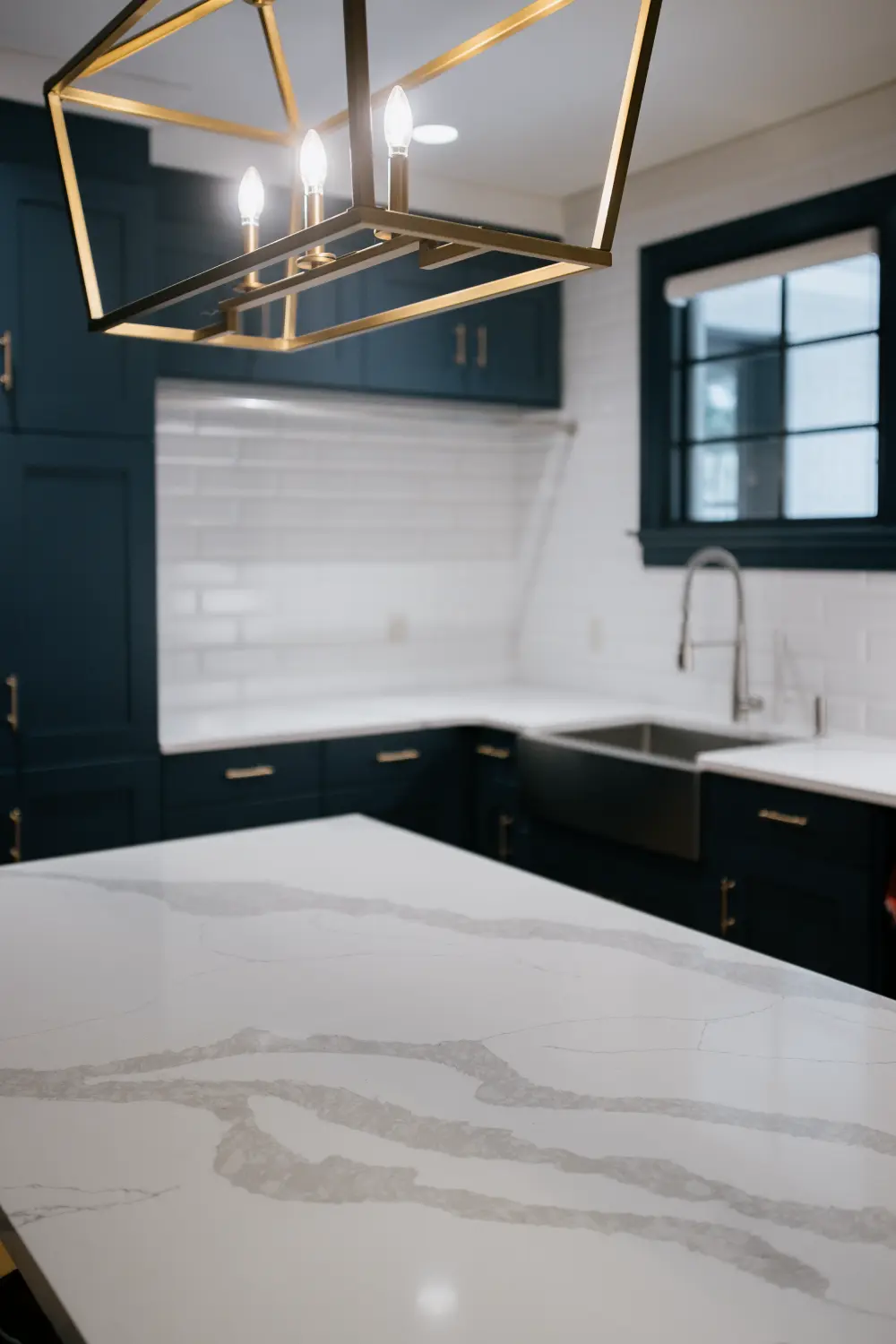
Engineered quartz can imitate marble-like veining, concrete, solid colors, fine patterns, or more traditional stone looks.
Because the appearance is manufactured, pattern and color are generally more predictable than natural granite.
Quartz vs Granite at a Glance
| Factor | Quartz | Granite |
| Material type | Engineered surface | Natural stone |
| Pattern consistency | More controlled | Naturally variable |
| Sealing | Generally not required | Some stones may benefit from sealer |
| Stain resistance | Very good when intact | Varies by stone and treatment |
| Heat | Resin content requires care with high heat | Natural stone generally handles heat well |
| Scratch resistance | Strong for normal use | Strong for normal use |
| Maintenance | Low | Low to moderate depending on stone |
| Uniqueness | Consistent design options | Every slab is unique |
| Outdoor use | Manufacturer-dependent; UV can affect some quartz | Often more suitable, subject to stone and installation |
| Repair | Depends on damage | Depends on damage and stone |
Which Is More Durable?
Both materials can perform well in busy kitchens.
Quartz Durability
Quartz is hard, nonporous, and resistant to many common household stains. It does not need routine sealing. However, the resin component means homeowners should avoid placing very hot cookware directly on the surface.
Granite Durability
Granite is also hard and highly durable. It generally offers strong heat resistance, although thermal shock and damage are still possible. Natural stone can chip at vulnerable edges if struck with heavy objects.
Neither surface is indestructible. Cutting boards and trivets are still good habits.
Quartz vs Granite for Stain Resistance
Quartz has an advantage in routine stain resistance because the engineered slab is nonporous.
Granite’s porosity varies. Some granite is dense enough to resist moisture effectively, while other slabs may benefit from an impregnating sealer.
The Natural Stone Institute notes that not every natural stone countertop requires sealing and that sealing improves stain resistance rather than making stone completely stain-proof. Ask your fabricator about the specific slab instead of assuming every granite needs the same maintenance schedule.
Which Handles Heat Better?
Granite generally has the advantage for direct heat because it is natural stone without resin binders.
Quartz manufacturers typically recommend trivets or hot pads because high heat can discolor or damage the resin.
That does not mean granite should be treated carelessly. Sudden temperature changes and prolonged extreme heat can still cause problems. Using trivets protects both the countertop and surrounding finishes.
For households that frequently move hot cookware directly from the oven or range, heat habits are worth considering.
Which Is Easier to Maintain?
Quartz is often chosen as a low-maintenance kitchen countertop because it does not require sealing and cleans easily with mild products.
Granite maintenance depends on the specific stone. Many homeowners simply clean it regularly and reseal if recommended by the fabricator.
The Natural Stone Institute’s stone care guidance recommends avoiding harsh acidic or abrasive cleaners on natural stone and following appropriate care procedures.
Which Looks More Natural?
Granite is natural, so it wins by definition if authentic geological variation is the priority.
Some homeowners love seeing mineral movement and knowing their exact slab will not be duplicated. Others prefer the cleaner, more predictable pattern of quartz.
Modern quartz can recreate veining convincingly, but repeated pattern elements may still be visible across large installations.
See full slabs whenever possible rather than choosing only from a small sample.
Which Offers More Color Control?
Quartz generally provides more control.
If the design requires a precise warm white, soft gray, consistent charcoal, or repeatable veining pattern, engineered quartz can make coordination easier.
Granite selection is more about finding a slab whose natural coloration works with the room. That process can be exciting but less predictable.
What About Seams?
Both quartz and granite installations can require seams depending on slab dimensions, kitchen layout, transportation, and fabrication constraints.
Seam visibility is influenced by:
- slab color;
- pattern;
- seam location;
- edge profile;
- fabrication;
- adhesive color;
- cabinet layout.
Highly active granite can sometimes disguise seams through movement, while a very uniform light quartz can make a seam easier to notice. A skilled fabricator plans seam location to balance appearance and structural requirements.
Which Is Better Around a Sink?
Both can work very well around undermount sinks when fabricated and installed correctly.
Quartz’s nonporous surface is convenient around water. Granite can also perform well, but areas around sink cutouts should be maintained appropriately.
The sink cabinet, support, faucet holes, dishwasher venting, and seam placement all matter to the finished installation.
Which Is Better for a Kitchen Island?
Either material can make an excellent island surface.
Quartz can be useful when you want a consistent large-format design. Granite can create a dramatic focal point with natural movement.
For large islands, confirm slab size and seam possibilities before finalizing the cabinet footprint. Overhangs may also require structural support depending on depth and material.
Think About Edge Profiles
The edge can change how the countertop reads.
Common profiles include:
- eased;
- bevel;
- bullnose;
- half-bullnose;
- ogee;
- mitered or built-up edges.
Simple edges generally suit contemporary kitchens, while more decorative profiles can complement traditional cabinetry.
Not every edge is appropriate for every thickness, design, or material. Ask the fabricator what is practical.
Quartz Countertop Pros and Cons
Pros
- nonporous;
- no routine sealing;
- broad color selection;
- more consistent pattern;
- strong stain resistance;
- durable for daily use;
- many modern and marble-inspired options.
Cons
- resin can be damaged by excessive heat;
- some patterns may repeat;
- less natural variation;
- UV exposure can affect some products;
- seams can be noticeable in certain colors.
For homeowners researching quartz countertops in Lexington, KY, the strongest reasons to choose quartz are usually low maintenance and design consistency.
Granite Countertop Pros and Cons
Pros
- natural stone;
- each slab is unique;
- strong heat resistance;
- durable;
- wide range of natural colors;
- can create dramatic movement and depth.
Cons
- some slabs may benefit from sealing;
- natural variation can make matching difficult;
- fissures and mineral features are part of the stone;
- slab selection is more important;
- certain edges can chip if struck.
For homeowners considering granite countertops in Lexington, KY, natural character is often the deciding factor.
Which Is the Best Kitchen Countertop Material for Families?
For many busy families, quartz is attractive because spills are easy to clean and routine sealing is not required.
However, granite can also be a very practical family surface. The choice may come down to cooking habits and design preference.
Ask:
- Do children regularly prepare food?
- Are spills cleaned quickly?
- Do you use hot cookware often?
- Do you want natural stone?
- Do you prefer a consistent pattern?
- How much maintenance are you willing to do?
The best kitchen countertop material is the one that fits real household behavior.
Which Is Better for Resale?
Both are established premium countertop categories. Resale value depends on the overall quality and condition of the kitchen, local buyer expectations, installation quality, and whether the color and design appeal to the market.
Do not choose solely for hypothetical resale. A well-designed surface that works with the cabinetry, flooring, backsplash, and home style is usually more important than whether the material is quartz or granite.
Visit a Showroom and See Full Slabs
Small samples can be misleading.
A 4-inch quartz sample may not show the scale of the veining. A small granite sample cannot capture the movement across a full slab.
Top Service maintains countertop inventory that allows customers to view available materials. Seeing slabs in person helps homeowners evaluate color, movement, finish, and pattern before fabrication.
Questions to Ask Your Countertop Fabricator
- Is this exact slab or color available?
- Where will seams be placed?
- Does this granite need sealing?
- What cleaning products are recommended?
- What heat precautions apply to this quartz?
- What edge profiles work with the material?
- How will the island overhang be supported?
- What sink options are compatible?
- How are templates created?
- What should be completed before installation?
A countertop decision includes fabrication and installation, not just material selection.
FAQ
Is quartz better than granite?
Quartz is better for some households because it is nonporous, consistent in appearance, and requires little routine maintenance. Granite is better for others because it is natural, unique, and highly heat resistant. The right choice depends on cooking habits, design goals, maintenance preference, and the specific slab or quartz product.
Does granite always need to be sealed?
No. Different granites have different absorption characteristics, and some may not require sealing. The Natural Stone Institute notes that many stone countertops receive additional stain resistance from an impregnating sealer but not all require it. Ask the fabricator about the specific granite you select rather than following a generic schedule.
Can you put a hot pan on quartz?
Manufacturers generally recommend using trivets or hot pads. Quartz contains resin binders that can be affected by high heat. Even if brief exposure does not immediately create visible damage, direct heat is an unnecessary risk. Using a trivet is a simple way to protect the surface.
Which scratches more easily, quartz or granite?
Both are hard and resist normal household wear, but neither is scratch-proof. Avoid cutting directly on either material, both to protect the countertop and to protect knife edges. Chips are more likely at exposed edges from strong impacts than from routine food preparation.
Which stains more easily, quartz or granite?
Quartz is generally more stain resistant because it is nonporous. Granite’s stain resistance varies by stone and whether a sealer is appropriate. Prompt cleanup is recommended for both surfaces, especially with oils, wine, strongly colored foods, and harsh chemicals.
Is quartz or granite better for a Lexington kitchen remodel?
Both are strong options. Quartz works well when low maintenance and consistent color are priorities. Granite suits homeowners who prefer unique natural stone and strong heat performance. Top Service offers both quartz countertops Lexington KY homeowners use and natural granite options, so comparing full slabs in person can make the decision easier.
How do I choose between two countertop slabs?
View them under lighting similar to your kitchen and compare them with cabinet, flooring, backsplash, and paint samples. For granite, pay attention to the entire slab’s movement. For quartz, look at the full-scale pattern and possible repetition. Also confirm seam placement, edge profile, and maintenance requirements.
Compare Quartz and Granite With Top Service Custom Countertops
When comparing quartz vs granite countertops, focus on how the surface will actually be used. Quartz offers low maintenance, consistent appearance, and strong stain resistance. Granite offers unique natural variation, excellent durability, and strong heat performance.
Top Service Custom Countertops provides quartz, granite, marble, quartzite, solid surface, and laminate countertops in Lexington, KY. Visit their showroom at 120 Park Central Court in Nicholasville or call 859-881-3344 to compare materials for your kitchen.